There is a particular kind of confidence that comes not from wearing more, but from wearing the right thing you love. A single piece that catches the eye, stops the room and raises questions. A garment that people remember before anything else. This is a signature piece, and in the context of modern luxury, understanding what actually makes one is worth thinking about carefully – because the answer has changed.
Define your design codes – and choose the piece that feels both personal and timeless.
What Makes a "Signature Piece"
in Modern Luxury?
The Old Definition No Longer Holds
For most of the twentieth century, a luxury signature piece meant: a recognisable logo, a house monogram, a status signal. The Chanel quilted bag. The Hermès H buckle. The Louis Vuitton canvas. These were pieces that announced affiliation with a house, a taste level, and an economic bracket.
That model still exists. But it has quietly lost its grip on the most design-literate consumers. When everything is branded and every brand has an entry-level piece, the logo stops being a distinguishing signal. It becomes noise.
Modern luxury has shifted, and with it, the definition of a signature piece. Think of it like the finest restaurants that no longer print a fixed menu- what you’re served depends on what was available that day. Curated, seasonal, unrepeatable. Better for it.
What a Signature Piece Actually Communicates Today
The contemporary signature piece doesn’t say I can afford this label.
It says something harder to replicate: I know who I am.
That shift from affiliation to identity is the defining characteristic of signature design in the current moment. The most compelling pieces in any wardrobe are the ones that feel as if they could only belong to the person wearing them. They carry a point of view, reflect a certain aesthetic and are, in the truest sense of the word- personal.
This is why one-of-a-kind and limited-edition pieces have taken on such significance. A mass-produced item (however well-made) can be owned by anyone. A piece with a story, a traceable origin, a construction you can read with your eyes: that belongs to you in a way no logo, however recognised, can replicate.
The Four Design Codes of a True Signature Piece
If you want to identify (or build) a signature piece in modern luxury, there are four qualities worth looking for. Not all four need to be present, but the strongest pieces tend to carry at least three.
Legible construction.
A signature piece transparently shows its seams and mends – the repairs that mark a history rather than hide it, the structural details that only make sense when you understand the process behind them. Construction as narrative is one of the clearest markers of genuine craft, and genuine craft is the foundation of lasting luxury. The kind that is bringing almost forgotten skills back under the spotlight.
Material with memory.
The materials in a true signature piece carry history, either in origin or in wear. Vintage denim that has faded into its own particular wash. Linen that has softened through years of use. Fabric that comes from a specific place, a specific time, a specific wardrobe. Materials with memory give a piece depth that new fabric simply cannot.
A detail that rewards attention.
Signature pieces reveal themselves slowly. There is something (a label, a seam, a construction choice, a proportion…) that you only notice on second or third look. This is what creates the moment of recognition – the quality that makes people stop and ask.
Personal resonance over trend alignment.
This is perhaps the most important quality, and the hardest to define. A signature piece in modern luxury is not chosen because it is fashionable. It is chosen because it is right- right for you, your aesthetic and the story you want to tell. It may be of its moment, but it is not dependent on its moment- even ten years from now, it will still make sense on you.
How to Choose a Signature Piece That Feels Personal Yet Timeless
The pieces that become signatures are usually recognised rather than hunted – you encounter them and understand immediately that they belong to you. The temptation to approach the search like a shopping exercise rarely works. That said, there are useful questions to ask.
Does it reflect your design codes, not someone else’s?
Every person has an aesthetic vocabulary meaning: favourite colours, proportions, textures, silhouettes that always feel right. A signature piece should sit within yours, not someone else’s codes.
Would you still wear it in a decade?
Not because it is conservative or safe, but because it is deeply aligned with who you are. The pieces that last are the ones that were never really about the trend to begin with.
Does it have a story you want to tell?
A signature piece is, in some sense, a conversation starter. If you can articulate why this piece matters (because of its origin, making or simply meaning to you) then it has the depth that separates a signature from a statement.
Is it genuinely yours, or are you performing someone else’s taste?
This is the most honest question of all. Signature pieces work because they are authentic. The moment they become costume – worn for image rather than identity – they lose their meaning entirely.
One Object, One Story
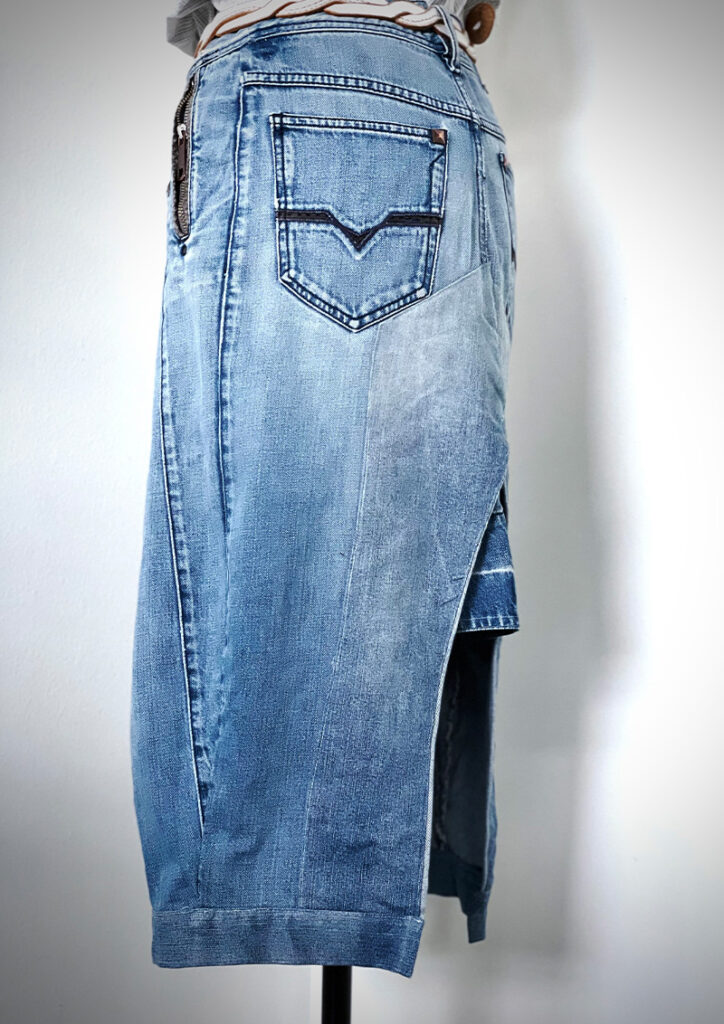
FrenzyLoop thinks about this constantly. Every piece created begins with a source (a garment with its own history) and ends with something new that carries that history forward. The Jeans-to-Skirt Nr2.1, for example, is reconstructed from upcycled denim, retaining the original waistband and hardware of the jeans it came from. The construction is visible. The material has memory. The detail that creates intentional layering in one single piece, rewards attention. Each piece in the series exists exactly once.
That is, in the end, what makes a signature piece in modern luxury. Not the name on the label. Not the price point. Not the season it belongs to. The fact that it is irreducibly itself and that when wearing it – so are you.
FrenzyLoop designs and makes circular upcycled fashion in Zurich.
Each piece is one of a kind.
Close the loop.
Enter the Frenzy Loop.