
Most of us have held a garment that just felt different. Something about the weight, the way it draped, the way it didn’t sag or pull or unravel at the first wash. We couldn’t always name what that was – but we were noticing craftsmanship details, and in reality, you don’t need technical training to tell a well-made garment from a poorly made one. You need to know what to look for – and where.
This guide will walk you through it.
What Makes a Garment Well-Made? Craftsmanship Details Explained
Start with the seams – they tell you almost everything
Turn the garment inside out. A seam is where two pieces of fabric are joined together, and the way it’s finished is one of the clearest indicators of overall construction quality.
In a well-made piece, seam allowances (the raw fabric edges on the inside) are finished cleanly. They might be enclosed in a thin strip of fabric (French seam), sewn flat against the garment (flat-felled seam), or bound with a narrow tape. What you shouldn’t find: raw, fraying edges, or a cheap overlock stitch that’s already beginning to loosen.
Also check that seam lines actually meet. At any point where two seams intersect (the underarm, a side pocket, a waistband join) the pattern should match up. Stripes that align across a seam, or a check that continues neatly from front to back panel, signal that the maker cut each piece individually and took care with placement. That takes time. Time costs money. It’s one of the honest signals of real craftsmanship.
Count the stitches (you only need to look)
You don’t need to literally count, but the stitch density on a garment matters. More stitches per centimetre means a stronger, more even seam that holds its shape under tension and over time. On the other hand- loose, widely spaced stitching is a shortcut. It uses less thread, sews faster, and fails sooner.
Look at the topstitching too- that is the decorative or structural stitching that sits on the visible face of the garment. On a well-made piece it runs in a perfectly straight, even line. If it wanders, bunches, or skips, that’s a sign of a rushed production process.
What the lining reveals
A lining is the fabric layer on the inside of a jacket, coat, or structured skirt. Its job is functional – to help the garment move smoothly over clothing underneath, to protect the outer fabric, and to give the structure some internal support.
Quality linings are cut with ease – they’re slightly roomier than the shell so the garment moves naturally without pulling the outer fabric tight. Poor linings are cut exactly to size, or even slightly small, which means every movement creates internal tension. The result is a garment that feels stiff, restricts your movement, or wears out faster because the lining is constantly under stress.
Feel the lining fabric itself. In well-made garments it tends to be smooth, breathable, and light – often silk, cupro, or a quality viscose. Scratchy, thin, or slippery-in-the-wrong-way linings are a cost-saving choice that you’ll feel every time you put the garment on
The finishing details that separate careful from careless
Finishing refers to everything that happens at the edges and endpoints of a garment – hemlines, buttonholes, buttons, pockets, waistbands, collar edges.
Buttonholes should feel firm and clean – the thread should be dense, the opening precise, with no loose threads or frayed edges. If a buttonhole looks like it was done in a hurry, it probably was.
Buttons should be sewn on with a shank (a small thread bridge between the button and the fabric that allows the button to sit properly when fastened). Without it, the button lies flat and pulls the fabric tight each time it’s done up. Bonus signal: spare buttons attached to an inside seam mean the maker expected the garment to be worn long enough to need them.
Hems on quality garments are often hand-stitched on the inside, which means you can barely see the stitching on the outside. Machine-rolled hems aren’t necessarily bad, but it depends on the garment – a hand-finished hem on a coat or tailored trouser is a labour-intensive choice that signals real attention
Pockets
Pockets – if there are any – should be properly reinforced at the corners where stress gathers. Bar tacks (tiny stitched blocks at pocket corners and belt loops) are a classic quality marker. Absent them, the pocket opening will eventually tear.
Construction: how a garment is actually built
Beyond the individual details, there’s the question of how the garment holds its shape. Structured garments – blazers, tailored trousers, formal coats – use internal layers to achieve this. A canvas layer (sometimes hand-stitched, sometimes fused with heat) sits inside the front of a jacket to give it body and help it drape over your chest without sagging.
The pinch test: pinch the fabric of a jacket lapel between two fingers and gently roll it. If you feel a separate, subtly stiffer layer moving independently beneath the outer fabric, that’s a canvas or interfacing at work. If it feels fused solid (like one flat unit) the structure was bonded with glue under heat. Glue fusing is faster and cheaper. It also tends to bubble and delaminate after repeated washing.
For softer, unstructured garments, look instead at how the weight is distributed. A quality unlined linen jacket drapes evenly. A cheaper version pulls at the shoulders, bags at the elbows, or twists slightly when worn.
These aren’t problems you notice immediately – they emerge over time, with wear.
Why it matters beyond the price tag
Understanding luxury craftsmanship details isn’t about learning to spend more. It’s about spending better – and keeping longer.
A garment built with care can be repaired when it wears. A seam that fails on a well-constructed coat can be re-sewn. A button that comes loose can be replaced, especially if there’s a spare. A fused lapel that has bubbled cannot be salvaged.
The construction choice made in production determines whether the piece has a long life or a short one.
These are the codes worth learning when you’re buying new.
They’ll help you tell the difference between a price tag and actual value – and make fewer, but better choices.
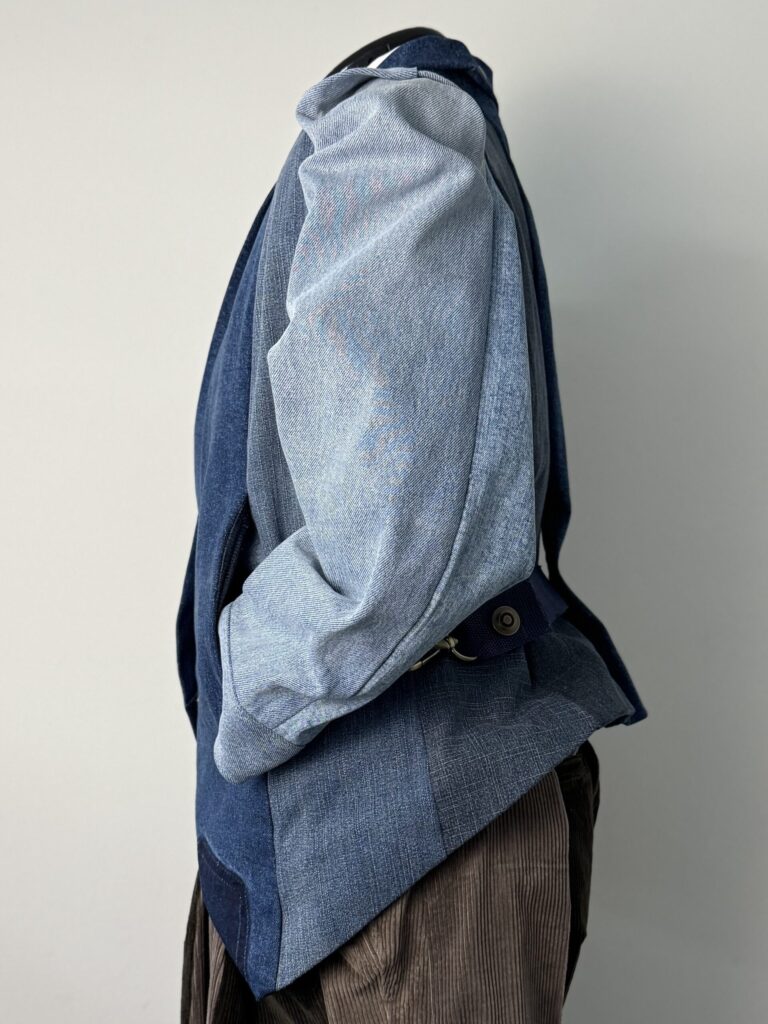
Take a look at this Four Blues Jacket. Upcycling operates on a different logic. When we work with an existing garment, we’re not starting from ideal conditions – we’re working with what’s there. Limited fabric, previous repairs, awkward cuts. Whenever possible, pieces are chosen and reworked based on construction quality, and the role of craftsmanship shifts towards building pieces that last – even when that means accepting imperfection.
The mission isn’t flawless seams. It’s giving something unwanted a reason to exist again. That’s a different kind of craftsmanship, and it doesn’t need to apologise for itself.
Close the loop.
Enter the FrenzyLoop.