
When it comes to upcycling and what that actually means, I like to quote William McDonough and Michael Braungart, and refer to their book Cradle to Cradle (an absolute must read for everyone who wants to understand where the problem lies), where they distinguish “downcycling” from “upcycling” and are arguing that an upcycled item must have at least the same, but preferably a higher, value than the original one.
Did you ever really think about how much impact your actions have on nature?
Yes, you’re in the right place – I was just asking out of curiosity, and I don’t really need an answer. But maybe you’ve already answered it to yourself.
The Slow Math of a Torn Sock
Being driven by these thoughts,
it took me a serious amount of time to think about what to do with soles from shoes that still look like they could live a long life, how to use bras once they’re no longer wearable, how to fix underarm holes on your favourite T-shirt, how to use those T-shirts once they’re really not wearable anymore, or what to do with socks once they get holes, or with the leftovers from other projects I’ve worked on.
I still haven’t figured everything out, but for some of these problems I’ve found solutions I’m quite happy with.
My Favorite “Inventions”
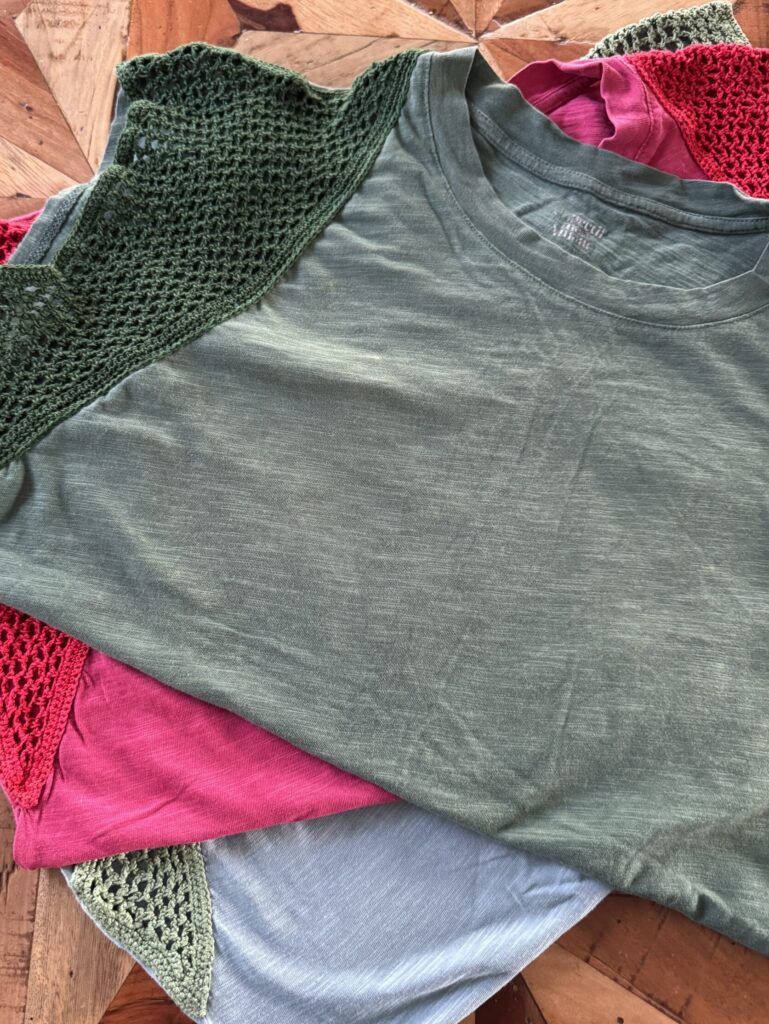
For those of you who are new here and haven’t yet discovered the FrenzyLoop Instagram or Pinterest accounts, I’ll introduce one of my favourite “inventions” – how to repair underarm holes on your favourite T-shirts. This is one of the clearest examples of an upcycled project genuinely ticking every box, and creating a better outcome than the original design offered.
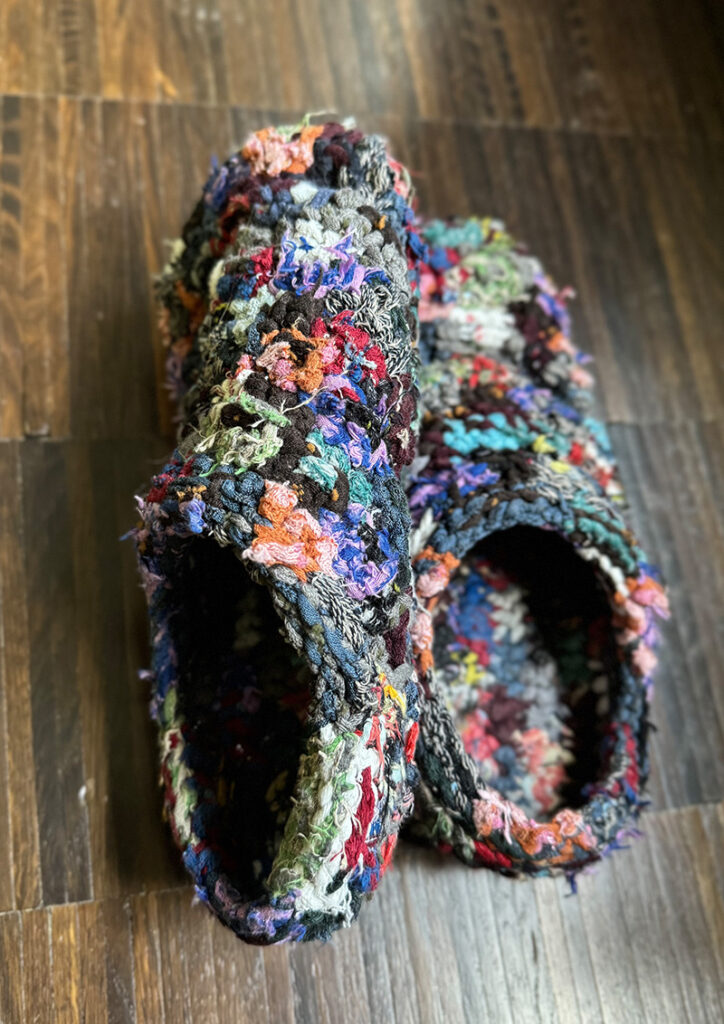
But the most interesting upcycling idea I’ve ever had was, actually – upcycling torn socks. Thinking about a sock’s loops like yarn was a real groundbreaking idea, at least for me. Three years ago I crocheted the first house slippers from sock-loops, and I still wear them today (repaired twice, but not visibly). They’re comfortable, warm enough for winter, perfectly fine for hot summer days too, and not slippery even without additional rubber dotting.
There is a catch, though: crocheting sock-loops is not the easiest process, and it leaves noticeable calluses on your fingers.
My limit is 6–8 hours a day, with at least 2–3 days of rest in between.
Starting from scratch?
Once you’ve collected enough unpaired and torn socks – let’s say one bag is enough to start – begin by cutting them and dividing the fabric into three groups: the ankle parts, the foot-and-leg body parts, and the heel-and-toe cutouts.
The ankle parts can later be turned into scrunchies, and the heel-and-toe cutouts shredded into filling material. The sock-body parts are the main component for the sock-loop yarn. Depending on the thickness and fabric quality or type of sock, cut the loops between 1-2 cm wide (the thinner the fabric, the wider the loops should be).
Depending on the fabric, size, and type, each sock will give roughly 10-15 loops. You’re ready to crochet once you have “enough” loops, but I’d suggest taking your time and cutting the whole stash at once rather than piece by piece.
All socks are welcome, but how the end product looks will depend directly on the colour combinations you choose – from completely black or white, to a full mix, which is how I like to do it. Here’s the other calculation: top crocheting speed would be one home slipper a day. But realistically, I’d say three days minimum for a pair.
I love to compare upcycling with fine dining, and since vegetarians just have to cook more (especially when they’re foodies), I’ll borrow from Yotam Ottolenghi’s “one day shopping, one day cooking, one day cleaning” – just this time as: months of collecting, days of cutting, and days of crocheting.
You can find sock-upcycling pieces in the FrenzyLoop shop, and if the prices are too high for you, I’d genuinely encourage you to try it yourself. It’s a very slow, but also very rewarding, process, with plenty to choose from in terms of what to crochet: slippers, bags, baskets, or even a jacket, if you’re very patient and persistent.
How Upcycling fits into Luxury
And let’s go back to the older posts speaking about what luxury is and how upcycling fits into it. Luxury is often defined as something “highly desirable, enjoyable, and often expensive that is not an absolute necessity for life.”
That’s a completely different subject and angle to look at things (and a separate post, probably) but I’ll just say this: upcycling, in general, isn’t just about clothing or fashion. It’s about using what already exists to create something new, and in doing so, prolonging the “grave” part of a product’s life – the part manufacturers rarely design for, because most products still aren’t built with Cradle to Cradle principles in mind. Almost everything made today is designed to eventually become waste, not to return to use.
A piece that took months of collecting and days of careful handwork to make pushes back against exactly that – when the raw material costs nothing and the entire value lies in the hours, the judgment, and the fact that it can never be exactly repeated. This is the luxury we actually do need, and it has to become “an absolute necessity for life” itself.
Is Upcycling the Real Solution?
And yet, to be fully honest about where that leaves us: McDonough and Braungart weren’t arguing for better recycling or upcycling – they wanted the whole system of manufacturing rebuilt, so nothing would need saving in the first place. I agree with them. But manufacturers haven’t caught up, and won’t for a long time.
So the question isn’t “is upcycling the real solution”, it isn’t (and they see it as slowing down an inevitable trip to landfill rather than solving anything). The question is what to do while we wait.
Prolonging a sock’s life by hand isn’t the fix they imagined. It’s just what’s left to do in the meantime.
I hope I’ve managed to inspire you – and if I did, I’d love to see your own work.
Happy upcycling.
FrenzyLoop designs and makes circular upcycled fashion in Zurich.
Each piece is one of a kind.
Close the loop.
Enter the FrenzyLoop.