What Novelty in Fashion Actually Means?
What “new” actually means and why this matters beyond FrenzyLoop
Virgil Abloh’s 3% Rule argues that only 3% difference is enough for a design to be considered new. That 3% is enough to file a new design, run a new campaign, fill a new collection. The system is built on it.
This logic is the absolute opposite of what I’m developing at FrenzyLoop. When I first came across it, my immediate reaction was “how is that even possible” – but then it started making sense. People need familiar silhouettes, known shapes, predictable forms. They reach for recognised logos as a kind of value confirmation. The 3% rule understands this perfectly.
What “new” actually means here
A hem raised two centimetres. A cropped blouse or a blazer. A familiar form in a new seasonal colour. These small tweaks keep the machine running – fast, smooth, familiar. They don’t raise questions like “what do we do with our dead stock?” or “what happens to a piece when it breaks?”
Those questions don’t get asked because they don’t generate profit, and profit is the main turning wheel.
My process has completely different grounds and motives.
Design-wise…
When I get an idea, I look for similar existing models first. I only go further if I don’t find them. I have favourite brands and designers, and their influence probably shows up in my work – but it’s never intentional copying, and rarely even direct inspiration. I understand the impulse to recreate something seen online. It’s just not my thing.
Concept-wise…
Every piece I make starts with something that already exists. I don’t begin with a mood board and source fabric to match it. My mood boards are all around me: photos I’ve taken, places I’ve visited, books I’ve read. Reminders my brain returns to when an unwanted garment comes into my hands, or when an idea arrives mid-way through finishing something else. At FrenzyLoop, I begin with the object: its particular fabric, its weight, its colours, its history. Then I work out what it can become.
Scale-wise…
With this approach, scaling for faster production in larger quantities simply can’t work. And I wouldn’t want it to. The constraint changes everything about the design process, but it also brings a specific kind of freedom and satisfaction when a finished piece genuinely ticks every box.
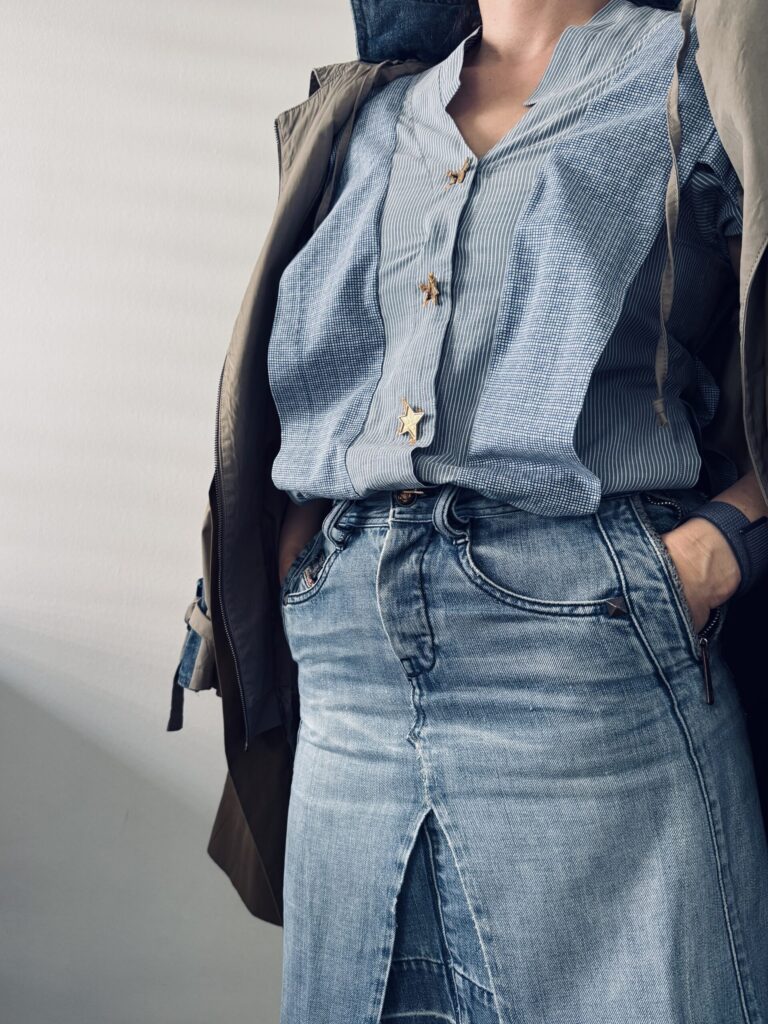
When you work from a source garment, you can’t default to an exact formula. The Jeans-2-Skirt Nr2.1 isn’t a template I’ll clone- it’s a response to that one specific denim. The layered front panels that make it read as two skirts worn together will each time produce a similar but different outcome.
That’s the whole point: repeat the logic, but let the history show.
There’s no “also available in navy.”
When it’s gone, it’s gone.
The circular logic the system ignores
Conventional fashion runs on a take-make-waste linear model. A few voices advocate for change – more transparent production, cleaner fibre processes, upcycled lines like those from Stella McCartney or Miu Miu. But it’s difficult to claim circularity when the underlying structure still depends on continuous newness.
True circularity means garments and materials kept at their highest value through continuous loops – reused, repaired, eventually remade. That’s exactly where FrenzyLoop stands: circularity as the design logic itself, not an add-on or a marketing angle.
Novelty versus something that lasts
Vivienne Westwood is my enduring reference. I love the deconstruction and reconstruction of Junya Watanabe and Sacai, the deliberate strangeness of Maison Margiela, the prints of Dries Van Noten that never seem to age. These are real design languages. But those garments are made in ateliers, from unlimited material sources – and the most interesting pieces exist only on runways.
FrenzyLoop works in a different register entirely. What I want is for it to become known as the place where interesting, beautiful, unique, wearable, and circular design exist under the same roof. Pieces made for real life. Pieces that will still exist in thirteen years because they were built to.
I still wear garments I made years ago.
I still get compliments on them.
That’s the benchmark I actually care about.
Why this matters beyond FrenzyLoop
The 3% model works because you’re not really selling a garment – you’re selling the feeling of newness in a familiar enough form. Each new thing expires quickly and requires constant replacement. The system needs you to need more.
Circularity has the opposite logic.
A garment that lasts, that can be repaired, that can re-enter the Loop when you’re done with it – that garment is a structural problem for a system built on turnover. It doesn’t require you to buy again. It doesn’t expire.
This is why FrenzyLoop exists as a structure, not just a brand. The Loop isn’t a marketing concept. It’s the actual mechanism: bring the piece back when it needs repair, or when you’re done with it, and it doesn’t end.
The cycle continues.
The material keeps living.
What FrenzyLoop is not
FrenzyLoop is not sustainable fashion that’s really just greenwashed novelty.
FrenzyLoop is not upcycling as craft hobby.
FrenzyLoop is not a brand offering a range.
FrenzyLoop is one person, working from what exists, making pieces that are genuinely resolved and designed to outlast the conversation about them.
That’s a harder thing to sell than a seasonal collection but it’s also the only thing worth making.
FrenzyLoop is a Zurich-based design studio working exclusively with pre-loved garments.
Every piece is one of a kind.
Close the Loop.
Enter the FrenzyLoop.